

Marketing hemp-derived products like Exhale’s THC gummies through search engines requires specialized SEO expertise that goes far beyond standard e-commerce tactics. The hemp gummy industry faces unique challenges: major advertising platforms ban or severely restrict hemp content, Google’s algorithms flag cannabinoid products differently than other supplements, and evolving regulations mean your SEO strategy must balance visibility with compliance.
Finding the right SEO partner for your hemp gummies business means identifying providers who understand these constraints and know how to work within them. You need someone who can build organic traffic without triggering platform penalties, craft content that educates without making prohibited health claims, and adapt quickly to regulatory shifts. The recent regulatory landscape makes this even more critical.
Most traditional SEO agencies lack experience with cannabinoid marketing restrictions. They may promise results using tactics that work for standard products but will get your hemp business penalized or deindexed. The hemp space demands technical SEO knowledge combined with deep familiarity of FDA guidelines, state-by-state legal variations, and the specific content restrictions search engines apply to hemp-derived products.
This guide walks you through what makes hemp gummy SEO distinct, how to evaluate potential providers, which service models work best for this regulated niche, and the common mistakes that waste marketing budgets without delivering compliant, sustainable growth. Whether you’re launching your first hemp product line or scaling an established brand, understanding these fundamentals will help you make an informed investment in SEO that actually drives sales.
Understanding the Hemp Gummy Market Landscape
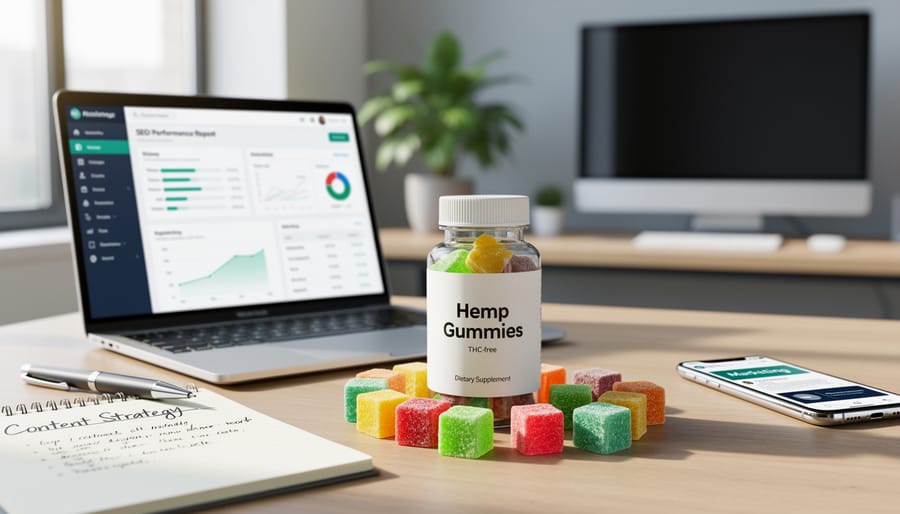
The hemp-derived THC gummy market exists in a gray zone that makes it one of the most challenging niches for digital marketing. Under the 2018 Farm Bill hemp definition products containing less than 0.3% delta-9 THC by dry weight are federally legal, creating a pathway for delta-8, delta-10, and other hemp-derived cannabinoids to reach consumers. This legal loophole has fueled rapid market growth, but it’s also created confusion among platforms, payment processors, and advertisers about what constitutes compliant marketing.
The landscape is about to shift significantly. On November 12, 2026, H.R. 5371 takes effect and switches the measurement standard from delta-9 THC alone to total THC. This means products that are currently legal may no longer qualify as hemp, forcing manufacturers and retailers to reformulate or risk losing federal protection.
This regulatory complexity creates unique SEO challenges that standard e-commerce strategies can’t address. Major advertising platforms like Google and Meta restrict or prohibit paid ads for hemp-derived THC products, even when they’re federally legal, pushing businesses to rely almost entirely on organic search. Keywords require careful navigation, terms that work for CBD won’t necessarily work for THC gummies, and compliance-focused content must educate consumers about legality without making health claims that trigger platform violations.
Geography adds another layer. While a product may be federally legal, state laws vary wildly, and shipping restrictions change frequently. Your SEO strategy must account for these jurisdictional differences, especially since cannabinoids cannot cross certain borders, for example, it’s illegal to take cannabis across the Canadian border in either direction. Standard digital marketing playbooks don’t cover these scenarios, which is why specialized expertise matters when buying SEO services for this category.
Key Factors When Choosing SEO Services for Hemp Products

Regulatory and Compliance Expertise
Your SEO partner needs regulatory fluency, not just marketing tactics. Under the 2018 Farm Bill, hemp products must contain less than 0.3% delta-9 THC by dry weight to remain federally legal. That standard changes on November 12, 2026, when H.R. 5371 switches to total-THC measurement, a shift that will force many current products off the market and reshape keyword strategy overnight.
Compliance expertise also means understanding container restrictions. Cannabis extracts face a 1,000 mg per container limit which applies to the entire jar or bottle, not just a single gummy. An SEO provider who ignores this detail might optimize product pages for high-dose offerings that regulators will pull.
These rules directly affect your content. A provider who doesn’t grasp the regulatory nuance will target keywords like “strongest hemp gummies” without recognizing that strength claims can trigger enforcement actions. They’ll write product descriptions that violate labeling requirements or create content that becomes obsolete the moment regulations shift. Choose a partner who monitors rule changes, understands how total-THC differs from delta-9, and builds keyword strategies that won’t expose you to compliance risk six months down the line.
Platform-Specific Advertising Knowledge
Most major advertising platforms maintain strict policies that severely limit or outright ban paid promotion of hemp-derived THC products. Google Ads prohibits advertising products containing THC, even when those products are federally compliant under current hemp law. Facebook and Instagram enforce similar restrictions, treating hemp-derived THC gummies the same as cannabis products regardless of legal distinctions. TikTok, Pinterest, and LinkedIn also block paid ads for THC-containing items, leaving businesses with virtually no mainstream paid advertising channels.
These platform restrictions apply even to products that meet the current federal definition of hemp (less than 0.3% delta-9 THC by dry weight) and will continue after the November 12, 2026 regulatory shift to total-THC measurement. The blanket bans stem from platform policies designed to comply with state-by-state variability and international user bases, not just federal frameworks.
This advertising landscape makes organic SEO not merely helpful but essential for hemp gummy businesses. Without access to pay-per-click campaigns, social media ads, or display networks, your visibility depends entirely on search rankings, content authority, and unpaid discoverability. Businesses that invest in strong SEO foundations, educational content, and compliant link-building strategies gain a decisive advantage in a market where competitors cannot simply buy their way to the top of search results.
Content Strategy and Educational Marketing
Educational content serves as the foundation of effective hemp gummy marketing when advertising channels remain restricted or prohibited. Because mainstream platforms limit direct product promotion, your SEO strategy must prioritize content that answers genuine consumer questions: What’s the difference between delta-8 and delta-9 THC? How do serving sizes affect experience? What does the shift to total-THC measurement in November 2026 mean for product selection?
This approach builds organic visibility while establishing your brand as a trusted authority. Content that explains the 2018 Farm Bill’s 0.3% delta-9 THC limit, clarifies container restrictions (the 1,000 mg immediate-container rule for extracts), or guides consumers through dosage considerations addresses real search queries and drives qualified traffic without making unverifiable health claims.
Effective educational marketing also differentiates your products through transparency. When consumers understand how your gummies are tested, why certain formulations meet federal standards, and what to expect from different cannabinoid profiles, they’re more likely to convert. The key is providing substantive, accurate information that helps people make informed decisions rather than promotional copy that triggers platform violations or erodes trust through vague promises.
Types of SEO Services Compared for Hemp Businesses

Selecting the right SEO service model matters as much as choosing the right partner. Hemp businesses have four main options, each with distinct advantages and limitations depending on your budget, in-house expertise, and growth stage.
Full-service digital marketing agencies offer comprehensive solutions that extend beyond SEO into paid media, social strategy, and brand development. They typically assign account teams with multiple specialists, handle everything from technical audits to content creation, and provide detailed reporting dashboards. These agencies work best for established hemp brands with monthly budgets exceeding $5,000 and complex needs across multiple channels. The downside: they rarely specialize exclusively in hemp, so you may need to educate them about regulatory nuances. Their broader client roster also means less focused attention on the unique challenges of hemp-derived products.
Specialized cannabis and hemp marketing firms bring critical niche expertise. These providers understand platform restrictions, know which keywords trigger advertising bans, and stay current with regulatory shifts like the November 2026 total-THC measurement change. They’ve navigated similar challenges for other hemp clients and maintain relationships with compliant link sources. Pricing typically ranges from $3,000 to $10,000 monthly, with project-based work starting around $2,500. Mid-sized hemp gummy companies benefit most from this model, especially those scaling beyond their first year. The limitation: the pool of truly specialized firms remains small, and demand often exceeds capacity.
| Service Type | Best For | Typical Cost Range | Key Considerations |
|---|---|---|---|
| Full-Service Agency | Established brands, multi-channel needs | $5,000, $15,000/month | Broad capabilities but may lack hemp-specific compliance knowledge |
| Specialized Hemp Firm | Growing hemp businesses, compliance-focused brands | $3,000, $10,000/month | Deep niche expertise, limited availability, higher specialization premium |
| Freelance SEO Consultant | Startups, businesses with in-house marketing teams | $75, $200/hour or $1,500, $4,000/month retainer | Flexible and cost-effective but relies on one person’s bandwidth and knowledge |
| DIY Platforms | Very small operations, tight budgets, learning-focused owners | $50, $500/month subscription | Lowest cost but requires significant time investment and lacks personalized strategy |
Freelance SEO consultants offer flexibility and personalized attention at lower price points. Experienced freelancers charge $75 to $200 per hour or work on monthly retainers between $1,500 and $4,000. This model suits startups with some marketing staff who need strategic guidance rather than full execution. You’ll get direct access to the person doing the work, faster communication, and customized approaches. However, freelancers have capacity limits, may lack backup during vacations or illness, and might not cover all specialties in-house.
DIY SEO platforms and tools like Semrush, Ahrefs, or Surfer SEO provide software and educational resources for businesses handling marketing internally. Monthly subscriptions run $50 to $500, making this the most budget-friendly option. Small operations with tech-savvy owners who can invest learning time benefit from this approach. The trade-off is steep: these platforms don’t provide hemp-specific guidance, won’t monitor regulatory changes for you, and can’t replace strategic experience. Most businesses using DIY tools eventually graduate to hiring specialists once they recognize the opportunity cost of their own time.
Your choice depends less on which model is objectively better and more on matching service capabilities to your current stage, budget constraints, and internal resources.
What to Expect: SEO Service Components for Hemp Gummies
A professional SEO package for hemp gummies should include several interconnected components that address both standard optimization and the unique compliance challenges of this market. Understanding these elements helps you evaluate proposals and ensure you’re getting comprehensive coverage rather than isolated tactics.
Technical SEO Audits
Your provider should start with a full technical audit of your website, checking site speed, mobile responsiveness, crawlability, and indexing issues. For hemp gummy sites, this includes verifying that product pages aren’t blocked by, checking SSL certificates for secure checkout, and ensuring age-gate implementations don’t prevent search engines from accessing content. The audit should identify broken links, duplicate content, and structural problems that could hurt rankings.
Hemp-Specific Keyword Research
Standard keyword tools often miss the nuances of hemp terminology. Expect your provider to research how consumers actually search for these products, distinguishing between “CBD gummies,” “delta-9 gummies,” “hemp-derived THC,” and related variations. They should identify informational queries like “are hemp gummies legal” alongside transactional terms, and map keywords to user intent stages. This research must account for geographic variations, since some terms perform differently by state or region.
On-Page Optimization
Each product page, category page, and blog post needs optimization: title tags that balance keywords with compliance language, meta descriptions that entice clicks without making prohibited claims, header structures that organize content logically, and schema markup that helps search engines understand product details. Your provider should optimize for featured snippets on common questions while avoiding health benefit language that platforms flag.
Content Creation
A strong package includes regular content that educates consumers and builds topical authority. This means blog posts explaining product differences, guides on dosing and effects, comparisons between hemp-derived and other cannabinoid products, and answers to regulatory questions. Content must be accurate about the November 2026 total-THC measurement change and similar compliance matters.
Link Acquisition Strategies
Earning backlinks in restricted niches requires creativity. Expect outreach to industry publications, participation in hemp trade organizations, educational content partnerships, and possibly sponsorships of relevant events or causes. Your provider should avoid link schemes or low-quality directories that could trigger penalties.
Ongoing Monitoring and Adjustment
SEO isn’t static. Your package should include monthly reporting on rankings, traffic, and conversions, plus proactive adjustments as algorithms change, competitors shift strategies, or new regulations emerge. Regular check-ins ensure the strategy adapts to your business goals and market conditions.
Recommended Approach: Building Your Hemp Gummy SEO Strategy
A phased approach minimizes risk and builds sustainable visibility for hemp-derived THC products without overspending on strategies that don’t fit the regulatory reality.
Start with compliance and technical foundations. Before creating any content or pursuing links, audit your site for technical SEO fundamentals: fast load times, mobile responsiveness, secure HTTPS, clean URL structures, and proper indexing. Simultaneously, ensure every product page reflects current labeling requirements, particularly the 1,000 mg per immediate container limit, and prepare for the November 12, 2026 shift to total-THC measurement. This groundwork prevents costly rework later and ensures you’re not building visibility for a site that violates platform policies or federal rules. Budget three to six months and expect to invest in site architecture improvements, compliance review, and baseline keyword research tailored to hemp-specific search terms.
Next, build educational content that addresses real buyer questions: how hemp-derived gummies differ from cannabis products, dosage guidance, state-by-state legality nuances, and effects. This phase establishes trust and captures qualified leads who are researching before purchasing. Invest in blog posts, FAQ pages, and comparison guides that rank for informational queries. Since many platforms restrict or ban paid ads for hemp products, organic content becomes your primary customer acquisition channel, the SEO vs paid ads equation shifts heavily toward SEO in this niche. Allocate another six months here, with ongoing content production as part of your marketing budget.
Finally, scale through authority-building and link acquisition. Once foundational content ranks and drives traffic, pursue links from industry publications, wellness blogs, and regional business directories. Track which content converts best, then double down on those topics. Monitor regulatory changes closely; the November 2026 rule change will require swift content updates and possibly new keyword targeting. Expect measurable ranking improvements within nine to twelve months, but treat SEO as a long-term investment rather than a quick fix. Businesses that rush this process or skip compliance checks waste money on rankings they can’t sustain.
Common Mistakes to Avoid When Buying SEO Services

Many hemp businesses lose money and risk legal exposure by selecting SEO partners who lack sector-specific knowledge. The most damaging mistake is hiring a provider unfamiliar with hemp regulations, someone who treats your gummy brand like any other e-commerce site without understanding the 0.3% delta-9 THC threshold currently in effect or the November 12, 2026 shift to total-THC measurement. These providers often create content that violates platform policies or triggers compliance issues, leaving you with wasted budget and potential penalties.
Another critical error is allowing unverifiable health claims in your content. Search engines and advertising platforms closely monitor claims about treating medical conditions, and statements like “cures anxiety” or “eliminates pain” can result in immediate account suspensions. Your SEO partner must know how to write persuasive, compliant copy that educates without crossing regulatory lines.
Geographic restrictions also trip up businesses. In Canada, it’s illegal to take cannabis across the Canadian border in either direction, yet some SEO providers create nationwide campaigns without considering cross-border legal barriers or regional compliance variations. Your right marketing tactics must account for where you can legally ship and advertise.
Mobile optimization deserves equal attention. Over 60% of hemp product searches happen on phones, yet businesses often approve desktop-focused strategies that ignore mobile page speed, navigation, and checkout flows. Similarly, failing to monitor regulatory updates, like the upcoming 1,000 mg per immediate container limit for extracts, means your content and product descriptions can become non-compliant overnight. Build compliance monitoring directly into your marketing mix rather than treating it as an afterthought. Choose partners who proactively track policy changes and adjust your strategy before violations occur.
Questions to Ask Potential SEO Partners
When evaluating potential SEO partners for your hemp gummy business, asking the right questions can reveal whether a provider truly understands this regulated niche or is simply repurposing generic e-commerce tactics. Start by asking about their direct experience with hemp-derived products: How many hemp or cannabis clients have they worked with, and what results did they achieve? Request specific examples of how they’ve navigated platform restrictions, because a provider who claims they can “get you on Google Ads” likely doesn’t understand that paid advertising for hemp products faces significant limitations on most major platforms.
Dig into their approach to regulatory compliance by asking how they plan to adapt your strategy when the November 2026 total-THC measurement takes effect. A qualified partner should already be aware of H.R. 5371 and have a clear plan for adjusting content and keyword targeting around that shift. Ask what SEO tools they use for tracking rankings and whether they monitor regulatory news sources alongside performance metrics.
What experience do you have with hemp product SEO specifically?
Look for providers who can name specific hemp clients, describe compliance challenges they’ve solved, and explain how hemp SEO differs from standard e-commerce work. Generic answers are a red flag.
How do you stay current with platform policy changes?
A qualified partner should have a system for monitoring Google, Facebook, and other platform policy updates that affect hemp marketing, not just general SEO news.
What does your reporting include and how often do you provide it?
Expect monthly reports covering organic traffic, keyword rankings, content performance, and any compliance-related adjustments made to your strategy.
What are your contract terms and can you provide references?
Reputable providers offer reasonable contract lengths (often three to six months initially) and can connect you with current or past hemp clients who can vouch for their work.
Finally, ask how they handle content creation for hemp products, particularly around educational material that builds trust without making health claims. Their answer should demonstrate understanding of the fine line between informative content and prohibited therapeutic claims.
The hemp-derived THC gummy market represents a significant opportunity for businesses willing to navigate its complexities with the right support. As this guide has demonstrated, success in this space demands more than standard SEO tactics. It requires partners who understand the regulatory framework, anticipate platform restrictions, and can adapt strategies as the landscape shifts.
The November 2026 change to total-THC measurement makes specialized expertise even more valuable. Businesses that choose compliance-aware marketing partners now will be better positioned to adjust their messaging, update their content, and maintain visibility when these rules take effect. Those who treat hemp SEO as generic e-commerce marketing risk costly missteps, from inadvertent health claims to targeting strategies that violate platform policies.
Transparency should guide your selection process. The right partner will explain how they handle compliance challenges, provide clear reporting on what’s working, and stay current with both search engine algorithm updates and hemp regulations. They’ll build your strategy on educational content that earns trust rather than shortcuts that jeopardize your business.
This market rewards businesses that invest thoughtfully in their digital presence. Start by evaluating potential SEO partners against the criteria outlined here. Ask the tough questions about their hemp-specific experience, request references from similar businesses, and ensure their approach aligns with your growth timeline and budget. The opportunity is real, but only if you choose expertise over expedience.